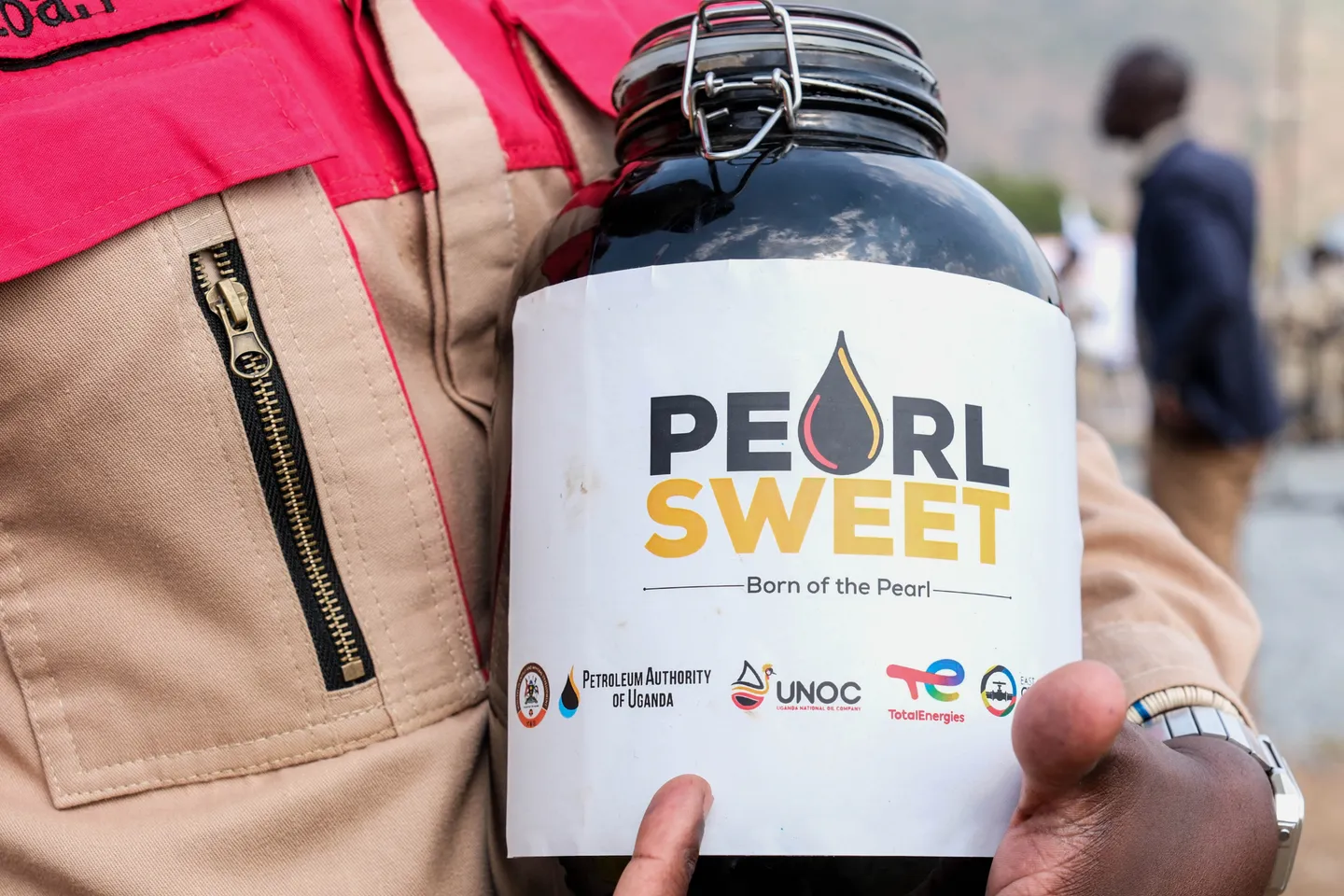
Ugandan authorities on Wednesday named the country’s prospective crude oil blend “Pearl Sweet,” marking a milestone as the East African country gears up for commercial production by the end of the year.
Officials announced the name at an oil infrastructure site, celebrating Uganda’s emergence as an oil producer.
The name chosen for Uganda’s crude oil blend is a nod to Winston Churchill’s description of Uganda in the last century as “the pearl of Africa,” and officials said the “sweet” in the nomenclature reflects the crude blend’s low sulfur content.
“The name combines national identity with a commercial description,” the Ministry of Energy said in a statement. “Naming supports future crude marketing activities and engagement with potential buyers.”
‘Important milestone’
Uganda is estimated to have recoverable oil reserves of roughly 1.6 billion barrels.
The investors are French oil company TotalEnergies, which owns the largest stake, and China National Offshore Oil Corporation, or CNOOC. The Ugandan people, through the Uganda National Oil Company, own 15% of the projects.




"This marks an important milestone in our journey to develop Uganda’s oil and gas resources for value addition and economic transformation," Ugandan President Yoweri Museveni said.
"Through refining, petrochemical industries and the use of associated gas for electricity generation, we shall maximize the value of our resources here at home and reduce dependence on imported petroleum products.”
Production is expected to plateau at about 230,000 barrels per day, with blended crude exports emerging from separate projects by CNOOC and TotalEnergies.
Legal setbacks
Wednesday’s event in Kikuube, the site of a CNOOC project known as Kingfisher, signals progress despite legal and other setbacks since the discovery two decades ago of commercially viable quantities of crude deposits.
The oil development projects are linked to the controversial construction of a heated pipeline linking Uganda’s oil fields near Lake Albert to a port in Tanzania. Environmentalists and others have opposed the pipeline, saying it runs afoul of the Paris Climate Agreement.