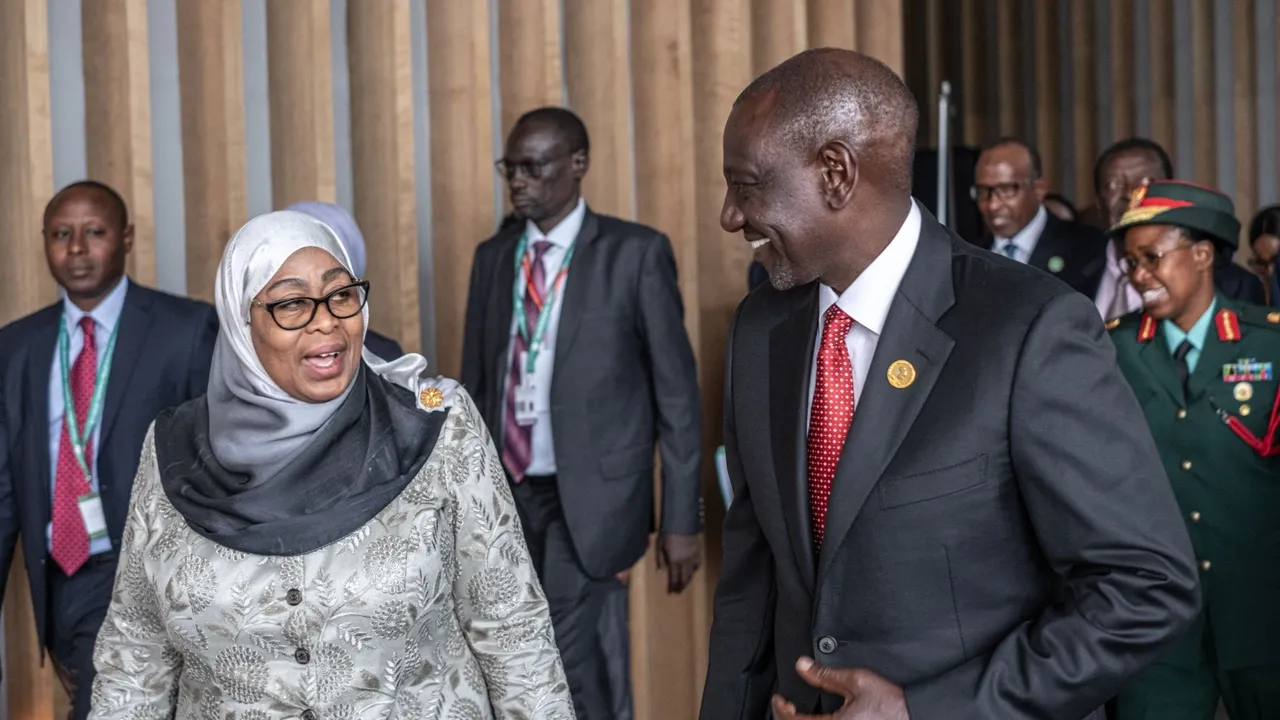
Kenya's President William Ruto is scheduled to address Tanzania's parliament in the capital Dodoma on Tuesday, May 5, Tanzania's Deputy Speaker Daniel Sillo announced on Wednesday.
Sillo told lawmakers that President Ruto's address to both the National Assembly and the Tanzanian nation will commence at 11am East African Time (0800hrs GMT).
"This important and historical event, which will also be attended by Tanzania's senior leadership, is aimed at strengthening cooperation and brotherhood between Tanzania and Kenya," Sillo said.
Ruto's address will mark the first time that a Kenyan president will be making a formal speech to a sitting of Tanzanian lawmakers.
President Samia Suluhu Hassan's address to Kenyan parliament
However, for Tanzania's case, President Samia Suluhu Hassan addressed a joint sitting of Kenyan parliament on May 5, 2021, nearly two months after she ascended to power following the death of her predecessor, John Pombe Magufuli. At the time, Kenya's president was Uhuru Kenyatta, who Ruto succeeded in September 2022.







Ruto's planned visit to the neighbouring nation comes on the back of plans by Kenya, Uganda, and Tanzania to build a regional oil refinery in Tanga, located in northeastern Tanzania, and around 340 kilometres north of Tanzania's commercial capital, Dar es Salaam.
Nigerian billionaire Aliko Dangote has expressed interest in building the refinery, saying he would come on board if the presidents of the three East African nations commit their support. Dangote, whose refinery in Nigeria is the largest in Africa, spoke at an investment conference in Kenya's capital, Nairobi, on April 23. Presidents Ruto and Yoweri Museveni of Uganda attended the event.
Kenya and Tanzania are traditional trade partners, with Kenya primarily sending refined petroleum, soap, and packaged medications to Tanzania.
Trade in numbers
Tanzania, on the other hand, exports agricultural produce, mainly maize and rice, raw materials, as well as energy commodities.
In 2024, the total value of Tanzanian goods to Kenya was $437 million, according to the Observatory of Economic Complexity (OEC). Nairobi, on the other hand, sent goods worth $488 million to its neighbour.