 Pauline Odhiambo
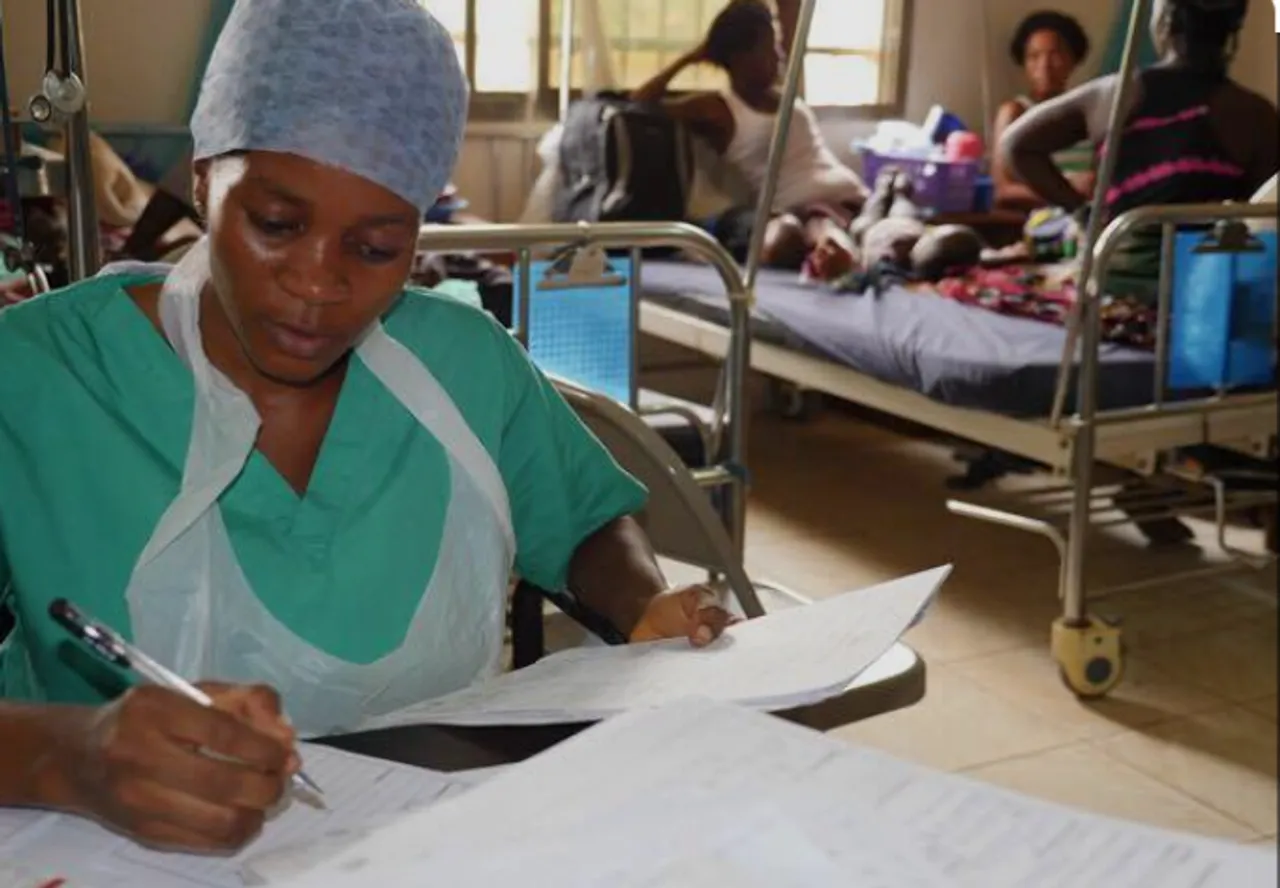
The night shift at one of the leading public hospitals in Nairobi had already claimed three hours of Mercy Achieng’s* energy when she sat down to chart a postpartum hemorrhage that should never have happened.
Mercy, a 34-year-old nurse from Kenya’s Kisumu County, had been working on the maternity ward for eight years. She knew the signs. She knew that the woman lying in Bed 12—a 22-year-old mother of twins who had come to the clinic earlier that evening —needed blood pressure monitoring every fifteen minutes. But tonight, there were forty-two mothers and forty-seven live babies on a ward built for twenty-five. Mercy was one of the three nurses on duty.
Her phone buzzed. A WhatsApp message from a multi-nationality nursing and midwifery group, which she had joined through a regional mentorship program. The notification read: “On International Nurses Day 2026, the WHO Academy recognizes the vital role of nurses and midwives in strengthening health systems and advancing Universal Health Coverage (UHC).”
Mercy almost laughed. Universal Health Coverage, here meant one blood pressure cuff for three or more patients and a broken infusion pump that no one knew how to repair.
Shared experiences
But then she scrolled further. A link to the state of the world’s nursing 2025 report. The numbers jumped at her: 29.8 million nurses globally, but 78% concentrated in countries representing just 49% of the population.
She had lived that statistic. She had watched colleagues migrate to the UK, to Saudi Arabia, to the US—not out of ambition, but because Kenya’s public system hired just about 1,200 new nurses per year for a population of over 50 million.
Mercy stayed because her aging mother lived in Kisumu. But staying meant chronic exhaustion, low morale, and the quiet terror of knowing that a single mistake—born of fatigue, not incompetence—could cost a life.
The WhatsApp message also included a statement from Dr Amelia Latu Afuhaamango Tuipulotu, the World Health Organisation Chief Nursing Officer: “Addressing this gap requires more than investment alone. It calls for coordinated action, shared experiences and sustained collaboration across countries and institutions.”
Mercy felt a flicker of something she had almost forgotten: recognition. Not pity. Not a headline. But a specific, policy-level acknowledgment that her daily reality was not inevitable.
The message linked to a new online training module from the WHO Academy—free, self-paced, optimised for low-bandwidth settings—on managing various emergencies with limited resources. She clicked save. Then she stood up, checked Bed 12’s blood pressure (still stable), and walked back to the crying twins.
Six thousand kilometers northwest, in a bustling stroke unit at a hospital in London, Emmanuel Ndlovu* was finishing his third twelve-hour shift in a row.
Emmanuel, a 41-year-old nurse from Bulawayo, Zimbabwe, had left his home country in 2019. Not because he wanted to. Because the Zimbabwean health system, already fragile, had collapsed further after a series of currency devaluations and a brain drain that saw 70% of specialist nurses leave between 2015 and 2022. Emmanuel had been a senior nurse at public hospital in Bulawayo where he once managed forty patients with paracetamol tablets and a prayer. Now in London, he had access to CT scanners, thrombolytics, and a nurse-to-patient ratio of 1:4 on a good day.
‘Draining one ward to fill another’
But the loneliness was a different kind of pathology. He missed the singing on the ward back home—patients’ families bringing porridge, the communal way that care happened when technology failed.




In London, efficiency ruled. And yet, on International Nurses Day on May 12, as the charge nurse pinned a small badge to his scrubs reading “Thank You,” Emmanuel felt hollow. He had just read the same state of the world’s nursing 2025 report that Mercy had seen. He understood, intellectually, that he was part of the 78% concentrated in a wealthier country.
But the report also noted something else: wide disparities in the availability of nurses remain across regions. He was the disparity. He was the gap that Mercy was living through.
He stepped into the breakroom and opened a recorded session from the WHO Collaborating Centre in the Caribbean, where nurses from seventeen countries had aligned their regional strategy with the Global Strategic Directions for Nursing and Midwifery (SDNM). He saw a nurse from Trinidad speak passionately about “education, jobs, leadership, and service delivery”—the four pillars.
Emmanuel thought of his former student, a young nurse named Thandi, still at Bulawayo, who texted him last week: “We have just three nurses for the whole medical ward today. Please send notes. Anything.”
He had been sending her scanned chapters from his London training manuals. But that was not collaboration. That was charity.
Then he saw a new announcement: the WHO Academy in Lyon had just launched a “Principles of Partnership” framework, developed with the University of Technology Sydney and Pacific island nations, which weaves local knowledge alongside participatory action research. It was not top-down. It was reciprocal.
Emmanuel realized that his experience—navigating two health systems, one broken and one resourced—was not a liability. It was expertise.
Ethical recruitment
The network’s call for shared experiences was not just about exporting Northern solutions to the South. It was about understanding how an African nurse from Bulawayo now working in London could advocate for ethical recruitment, fairer data sharing, and twinning programs that didn’t strip one country to serve another.
By 10 p.m. Nairobi time, Mercy had finished her charting. She opened the WHO Academy module on a cracked smartphone, the screen lighting up her tired face. For the first time in months, she learned something new: a low-cost method for measuring postpartum blood loss using a calibrated drape—something she could implement tomorrow with materials already on the ward. She made a note to share it with the other night nurses.
In London, Emmanuel messaged Thandi. Not just notes this time. A link to the “Principles of Partnership” framework, and quick voice note as he made his nightshift rounds. “We don’t need to save you from there. We need to build something together. I’ll connect you to the network.”
On International Nurses Day 2026, the WHO Academy moved its Office of the Chief Nurse from Geneva to Lyon, bridging data, policy, and practice. But in a crowded maternity ward in Nairobi and a sterile breakroom in London, the real work happened where it always had: in the hands of African nurses who refused to stop learning, and who finally had a global network that refused to let them learn alone.
As the shift ended, Mercy typed a message into the network’s discussion forum. Her words would be read in Sydney, in the Caribbean, in Central Asia, and by a former nurse from Bulawayo now drinking cold coffee in London.
She wrote: “You can move African nurses across borders. But you cannot move justice. True collaboration does not drain one ward to fill another. It builds capacity where it is weakest, and honors knowledge where it is strongest. That is the only universal health coverage I still believe in.”
*Names have been altered to protect identity