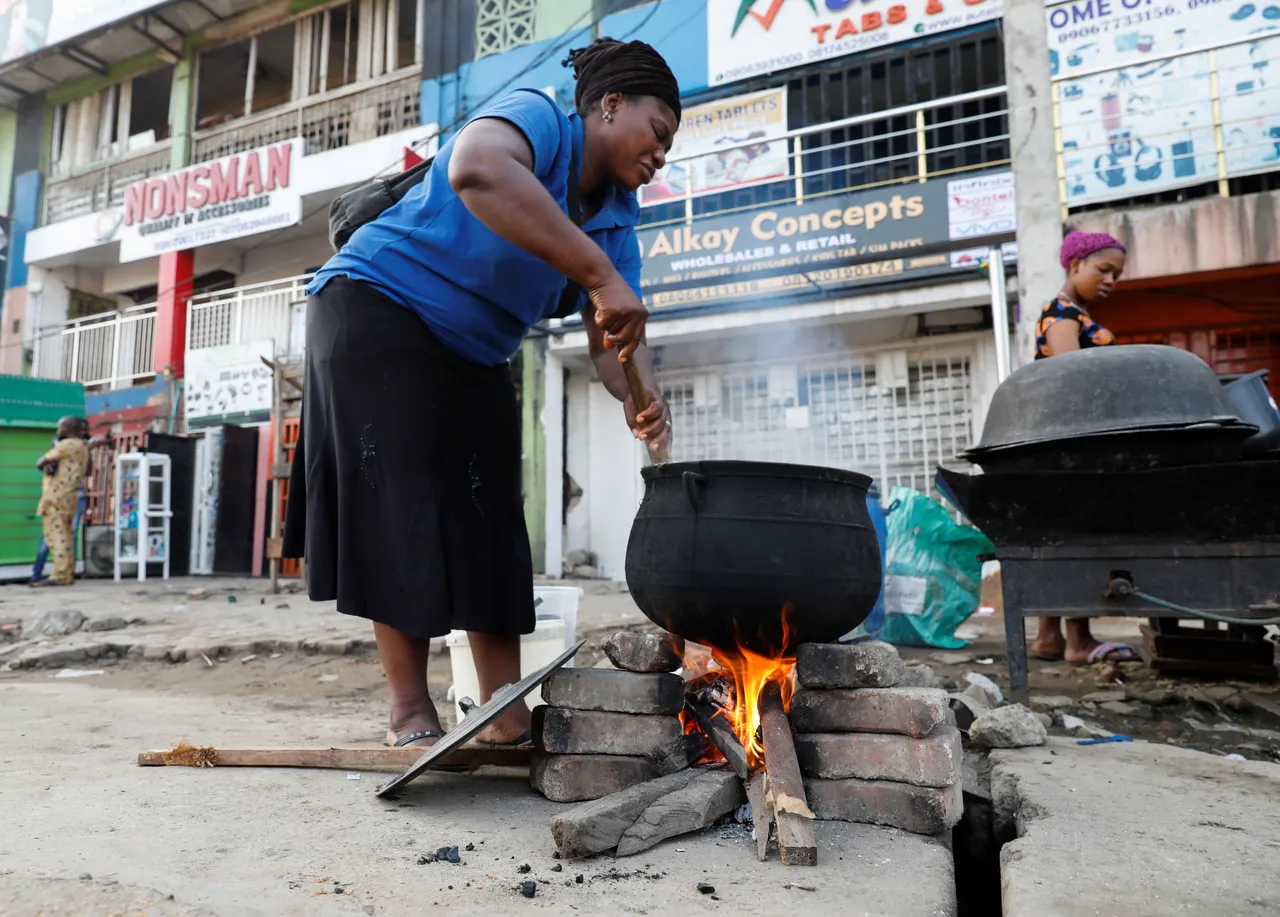
The family of Hajiya Aisha Aliyu, a housewife in Kano, northern Nigeria, shelved use of Liquified Petroleum Gas (LGP) otherwise known as cooking gas for charcoal and firewood.
“Before, we used to spend about 18,000 naira to 20,000 naira to fill a 12kg cooking gas cylinder which we used to buy almost twice a month. That is about N40,000 per month,” she told TRT Afrika.
The family that used to buy a kilogram of cooking gas for just about 1,083 naira could no longer continue buying it when the price rose by half. It had to resort to using charcoal and firewood as substitute.
“And now we don’t spend more than 10,000 naira per month on charcoal and firewood. Though they are difficult to use compared to gas, they are cheaper,” she said.
Rise and rise of gas prices
The price of cooking gas has not always been like this. Aisha’s family and many others in Nigeria used to buy a 12kg of cooking gas for 13,000 naira.
But a combination of factors such as foreign exchange volatility, rising logistics costs, infrastructure constraints and changes in international LPG prices have been pushing up the price of the commodity, according industry experts.
The average price of 5kg of cooking gas increased from 7,655.73 naira in March 2026 to 8,706.93 naira in April the same year as reported by Nigerian local media, citing Nigeria’s National Bureau of Statistics (NBS).
Though the above put the average price of a kilogram of cooking gas at 1,741 naira, the rise of the price of the LPG didn’t stop there. It has already gone above 2,000 naira in parts of the country with some reports saying a kilogram was sold for as high a 2,500 naira.
While many households in Nigeria have been quietly leaving cooking gas for charcoal and firewood, some families have been complaining about rising cost of the commodity.
Importation to the rescue
In response Nigerian government is looking to increased importation of liquefied natural gas as a solution.
The country’s Minister of State for Petroleum Resources Ekperikpe Ekpo noted the concern expressed by Nigerians on the surge in price of cooking, assuring that the government was committed to adequate, reliable and affordable gas supply for household and industrial use in the country.
“Marketers have committed to increasing import volumes to complement domestic production,” the minister was quoted to have said in a statement issued by his spokesman, Louis Ibah.
The minister assured that no locally produced of LPG designated for local consumption was being exported.
But Nigeria has the world’s ninth largest natural gas reserve with approximately 200 million cubic feet of gas, according to data from national and international agencies.
One may wonder why would a gas-rich country like Nigeria be importing LPG for domestic use.
Huge reserves







The simple reason is that Nigeria doesn’t produce enough LPG for domestic market despite its huge gas reserves, according to the president of Nigerian Association of Liquefied Petroleum Gas Marketers (NALPGAM), Edu Inyang.
People in government have also hinted at this in the past. Permanent secretary in Nigeria’s Ministry of Science and Technology, Mrs Monilola Udoh, recently said the only 25 % of the country’s huge natural gas reserves are being developed.
Inyang explained that while local LPG production had increased, many producers were still operating below installed capacity, leaving growing consumer demand unmet, according to a local report.
He attributed the unmet demand to inadequate storage facilities, high transportation costs, foreign exchange challenges and multiple handling charges within the supply chain.
He said LPG storage infrastructure remained concentrated in Lagos, the Edo/Delta axis and Port Harcourt, with limited facilities in northern Nigeria, increasing distribution costs nationwide.
Desertification problem
For years Nigeria as been battling with desertification occasioned by uncontrolled felling of trees without replacement. Nigeria’s Minister of Environment, Balarabe Lawal, recently said data showed that the country had lost 463,360 hectares of forestland to desertification.
“There is a general consensus that desertification is by far the most pressing environmental problem in the dry land parts of the country. It has been estimated that between 50 and 75 per cent of Bauchi, Borno, Gombe, Jigawa, Kano, Katsina, Kebbi, Sokoto, Yobe, and Zamfara states in Nigeria are being affected by it,” he said.
But as families that cannot afford cooking gas continue to turn to alternatives that like charcoal and firewood, so will the danger of desertification continue, according analysts.
The way out
Experts say the country needs to improve domestic production and supply of LPG with favourable policies for a stable affordable pricing to be maintained.
“With adequate domestic supply, improved infrastructure, exchange-rate stability and supportive government policies, the industry can achieve a more affordable and stable pricing environment,” Inyang said.
Apart from making gas available and affordable, analysts believe the country can do with public education on the importance of sticking to and or adopting cooking gas for safer environment.
God’sLove-Divine Ngbechukwuyem, a community development practitioner, is one of those with this view.
“Public education should focus on three concrete harms: health (indoor air pollution causes respiratory illnesses, especially in women and children near cooking areas), household finances, and local ecosystems,” Ngbechukwuyem told TRT Afrika.
“Meanwhile, government agencies, civil society, and the media must highlight the long-term consequences: deforestation, biodiversity loss, and greater vulnerability to climate disasters,” he said.
He added that lasting change would only happen when cleaner cooking becomes more affordable and accessible.