 Pauline Odhiambo
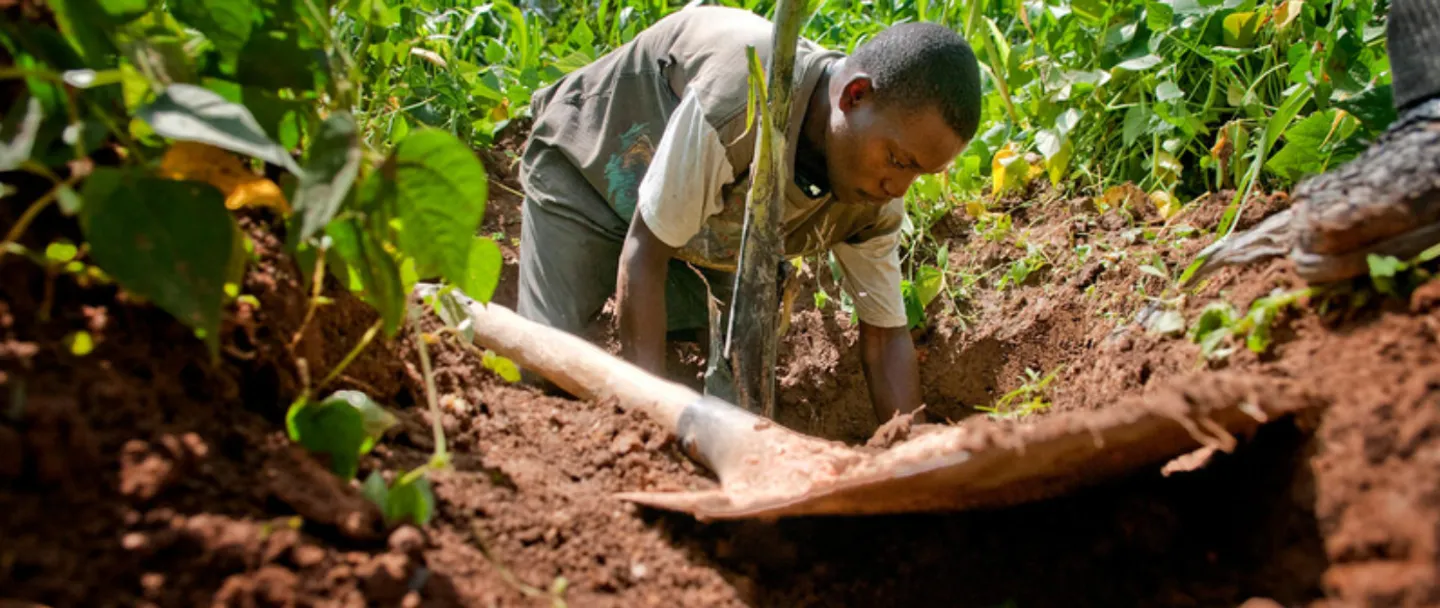
The sun rises over the rolling hills of Kimilili, Kenya, casting long shadows across a patch of land that tells a story of quiet redemption. For nearly two decades, Samuel Barasa tilled this soil, burning crop residues after each harvest, unaware he was slowly killing the very ground he depended on.
"I am among the farmers that used to burn maize residue and dry vegetation in the fields, oblivious of the harm I was causing my soil," he recalls with regret.
Today, that same earth pulses with life—spinach, beans and tomatoes flourish where nothing once would grow. Samuel's harvest has leaped from three bags to fifteen. But his story is not just personal triumph; it is a warning that desperately needed solutions are not spreading fast enough.
Across the continent, in the rice paddies of Nasarawa State, Nigeria, Fatima Ibrahim knows this struggle intimately. For years, the mother of five would broadcast 150 kilograms of rice seed across her plot, only to harvest 18 bags—barely enough to repay loans.
"By the time I repaid with my harvest, there was hardly anything left for my family," says Fatima. "We barely survived."
Then came regenerative agriculture training. Instead of broadcasting seeds, she planted them in nursery beds. Instead of 150 kilograms, she now plants just 50. She began producing biochar, a natural soil amendment. The transformation was staggering. From the same plot, she now harvests 60 bags.
"My income has doubled, and my home is much more peaceful," she says.
Sustainable soil management
These stories stand in stark contrast to the grim picture painted by a major new report by the Food and Agriculture organization (FAO). Launched at COP17, the Status of the World's Soil Resources 2026 delivers a sobering verdict: soil degradation is worsening globally, and adoption of proven solutions remains dangerously slow.
Since 2015, the global population has grown by 800 million people. More than half of regional assessments indicate low adoption of sustainable soil management. Fifty-eight percent report a deteriorating trend since 2015; only 10 percent show improvement.
Soil erosion emerges as the most severe threat. Across seven regions, 81 percent of assessments judge erosion management poor or very poor.







As Ibrahim Thiaw, Executive Secretary of the United Nations Convention to Combat Desertification (UNCCD), starkly puts it: "The land is the foundation of our prosperity and stability. When we degrade the land, we undermine our own future. This is not a distant threat—it is happening now, on every continent, and it is accelerating faster than our response."
But the gap between knowledge and action is deeply frustrating. Proven practices—reduced tillage, crop diversification, cover crops, organic amendments, and agroforestry—can mitigate soil threats while sustaining productivity. These are not experimental concepts, yet adoption lags.
FAO Deputy Director-General Beth Bechdol states: "We have much better evidence today about the pressures facing the world's soils—and about the practices that can protect and restore them. But this report makes clear that proven solutions are still not being adopted at the pace and scale required. The priority now is to give countries, farmers and other land users the knowledge, capacity and incentives they need."
Farmer ingenuity
The reasons are complex. Farmers like Samuel and Fatima did not resist change out of stubbornness; they lacked awareness and access. In Kenya, nearly 63 percent of arable land is acidic, yet many farmers were never taught to test or treat their soils. Cost is the biggest barrier at 35% followed by labor demands 22 % and limited knowledge at 20%.
Yet there is hope in farmer ingenuity. George Muturi Kamau in Kenya's Lari region turned to redworms to rescue his land from chemical degradation. His vermicomposting operation transforms waste into rich organic fertiliser. "Our soil is much better in a way that we can sustain the crop even during dry season," he says.
The FAO-UNCCD guidance, Living Soils, Productive Lands, Resilient Landscapes, calls for integrated management of productive landscapes. Five priorities guide the way: strengthening soil governance, promoting education, improving monitoring, strengthening incentives, and fostering inclusive decision-making.
For Fatima Ibrahim, these principles are not abstract—they are a new life. With increased income, she bought land, renovated her house, and purchased water pumps she rents to other farmers. "People come to my farm, see the results, and buy seeds from me," she says proudly.
And for Samuel Barasa, the man who once unknowingly starved his soil, the journey has come full circle. Now a trainer of farmers in his village, he speaks with quiet authority.
"I am a happy man because my soil is yielding where it did not," he states.