 Sylvia Chebet
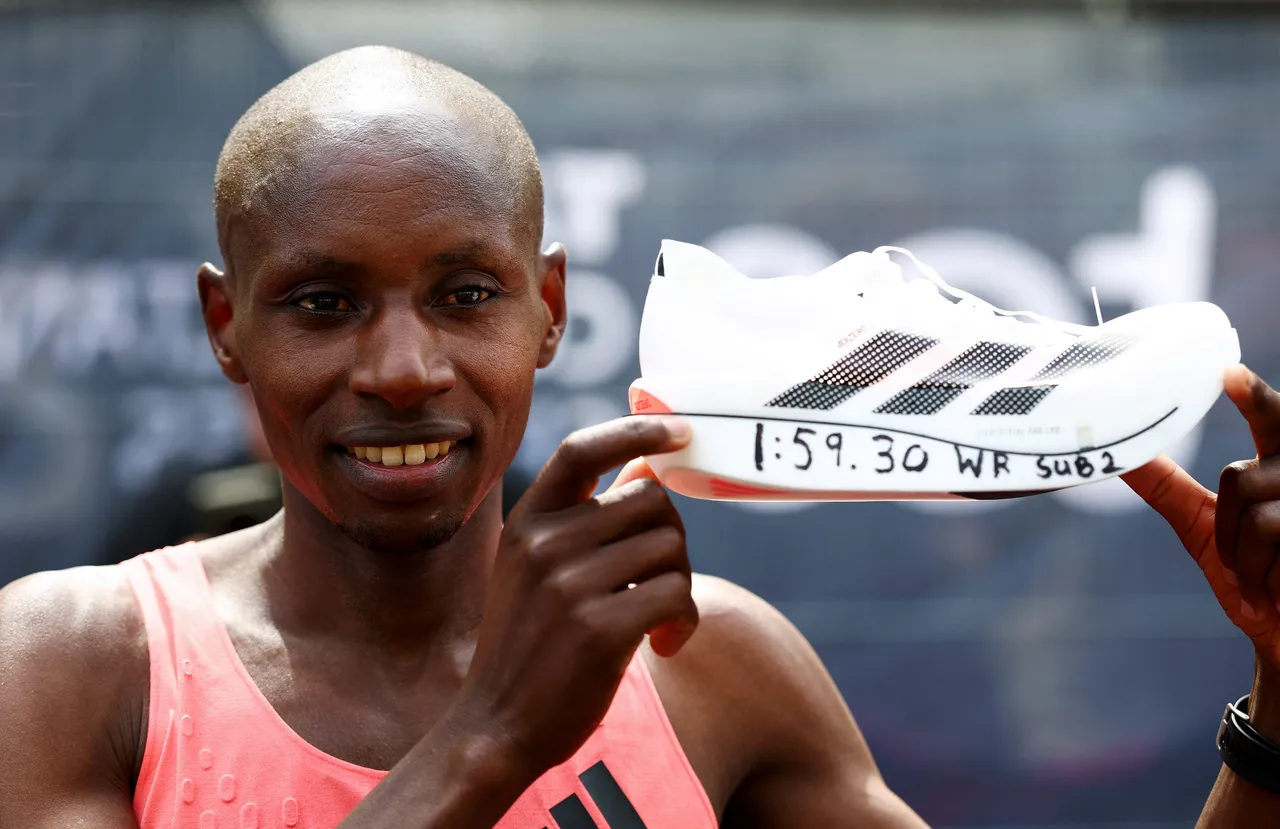
When Sabastian Sawe tore through the streets of London on April 26, 2026 and became the first man in history to run a marathon in under two hours, he instantly entered the pantheon of distance-running greats.
Yet almost immediately, debate followed.
How much of Sawe’s historic performance came down to talent, training, discipline, and mental toughness — and how much was driven by the supershoe on his feet?
Sawe’s coach said the Kenyan logged as much as 241 kilometres during peak training blocks. Years of sacrifice and preparation had led to the breakthrough. But the carbon-plated shoe he wore became a central talking point, at times overshadowing the athlete himself.
That tension captures a growing debate in modern athletics. Advances in shoe technology have transformed long-distance running, but they have also raised difficult questions about fairness, performance, and the limits of innovation.
In today’s marathon races, critics argue it is becoming harder to tell whether victory belongs to the strongest runner or to the athlete with the most advanced equipment.
“That’s why the debate has become so heated,” athletics analyst Martin Keino told TRT Afrika. “The conversation has shifted from asking, ‘Who is the best athlete?’ to asking, ‘Who has the best combination of athlete, foam, geometry and carbon technology?”
The debate accelerated in 2016 when Nike introduced the Vaporfly, a shoe that dramatically improved running efficiency. It marked the beginning of the “supershoe” era: footwear built with lightweight, energy-returning foam and carbon-fibre plates designed to propel runners forward.
Since then, nearly every major sportswear brand has developed its own version. Similar technology has also transformed track spikes, now commonly referred to as “superspikes.”
The results have been extraordinary. According to World Athletics, athletes wearing advanced footwear technology have broken every road and outdoor track world record from 5,000 metres to the marathon since 2020 — an unprecedented concentration of record-breaking performances.

Engineered for Speed
Modern supershoes are carefully engineered to improve what scientists call “running economy” — the amount of energy required to maintain a given pace.
Most combine three core elements; carbon-fibre plates that help propel the foot forward, specialised foam that compresses and rebounds efficiently and a curved rocker shape that smooths stride transition
The foams are considered the most important component. They absorb impact while returning energy with every foot strike, reducing fatigue over long distances. Some models also incorporate air pods or similar cushioning systems for additional bounce.
But soft foam alone would make shoes unstable. To counter this, manufacturers sandwich rigid carbon-fibre plates or rods between layers of foam, creating a balance between cushioning and propulsion.
The result is footwear that is not only highly responsive but also exceptionally light. Adidas’ Adizero Adios Pro Evo 1, released in 2023, weighs less than 140 grams in some sizes.
Scientists say lighter shoes reduce the energy cost of each stride because weight carried at the foot requires disproportionately more effort to move than weight carried closer to the body’s centre of gravity.
Research has also shown that stiff carbon elements can reduce muscular strain in the feet and calves, further improving efficiency.
For many athletes, the benefits extend beyond the clock. Supershoes can also reduce impact stress on the body and speed up recovery between hard training sessions.
The Rise of “Illegal” Shoes
As the technology evolved, so did concerns about regulation.








“The shoe technology has evolved so much so that now there are ‘illegal’ shoes”, Keino quips, adding, “because of how good they are,” Keino quips.
In elite competition, an illegal running shoe is one that violates World Athletics regulations. The governing body introduced tighter rules after concern grew that shoe design was advancing faster than the sport’s ability to regulate it.
“The rules are basically trying to stop the sport from becoming Formula 1 on foot.” Keino says.
World Athletics introduced the 40mm stack-height limit in 2020 after carbon-plated supershoes began dominating elite marathons. The prototype shoes must generally be commercially available before competition as well.
“The big issue is not whether the shoe exists commercially,” said Keino, a former Kenyan athlete who helped break seven world records as a pacesetter. “It’s whether the technology gives an unfair performance advantage beyond the rules.”
Much of the controversy traces back to Eliud Kipchoge’s famous sub-two-hour run in Vienna in 2019, achieved while wearing a prototype version of the Nike Alphafly.
“That performance pushed the sport into a technology arms race,” Keino said.
Several high-profile shoes have since been deemed non-compliant under elite racing rules, usually because they exceed stack-height limits or use prohibited design features. The governing body allows only one rigid embedded plate or blade structure on the shoe.
Athletes competing in non-compliant footwear can have performances invalidated or marked uncertified.
In 2021, Ethiopian runner Derara Hurisa crossed the line first at the Vienna Marathon in 2:09:22, only to be disqualified less than an hour later after officials measured his shoe soles and found them to be 5cm thick — exceeding the legal limit by one centimetre.
Keino says Hurisa had registered compliant shoes before switching to his training pair on race day.
More recently, Kenyan runner Paul Matheka was disqualified from the 2025 Kuala Lumpur Standard Chartered Marathon after wearing carbon-plated shoes that were not on the World Athletics approved list.
“He had bought the off-brand shoes at the expo, unaware they weren’t approved,” Keino explained.
A New Era — or an unfair one?
Critics argue the rapid pace of innovation has fundamentally altered the sport. Comparisons between past and present records have become increasingly complicated, while attention has shifted from athletes to equipment.
South African sports scientist Ross Tucker, one of the most vocal critics of supershoes, argues that footwear technology has introduced persistent uncertainty into elite competition.
He is quoted in MIT Technology Review saying: “It becomes difficult to evaluate performances between athletes independent of this nagging doubt over what the shoes do,” he has said.
Nowhere is that tension felt more strongly than in Kenya, where distance running has long represented a pathway out of poverty.
For established stars backed by lucrative sponsorships, access to cutting-edge footwear is almost guaranteed. For young, aspiring runners, however, supershoes can be prohibitively expensive, with even entry-level models often costing well over $100.
The result is a widening technological divide in a sport once celebrated for its simplicity.
Even so, few athletes today deny the reality of the revolution. Running — perhaps the most elemental sport of all — has entered a new scientific age.
Supershoes are changing training methods, reshaping race tactics, and redefining what the human body appears capable of achieving. They are also forcing athletics to confront a difficult question that may define the future of endurance sport:
When records fall, how much belongs to the athlete — and how much belongs to the shoe?