 Pauline Odhiambo
The day begins before the sun for Edna Monteiro. By 5:30 a.m., she has already bathed her two youngest children, prepared a breakfast of cuscuz and eggs, and walked her eldest to the bus stop for school. By 8 a.m., she is at her job as a cashier in a small supermarket in the capital’s plateau district. By 1 p.m., she races home to check on her elderly mother-in-law. By 7 p.m., she is back at the stove, cooking cachupa while helping with homework. She collapses into bed near midnight.
Edna, 34, is among the 46% of Cabo Verdean women in full-time employment. But the math of her life does not add up. Despite having completed secondary school—a level of education that many of her male colleagues lack—she earns 15% less per hour than the new male trainee hired last month. When asked why she doesn’t seek a better job, she laughs without humor.
“Look at my day. When would I study? When would I even apply?” she tells TRT Afrika from her home in Praia, Santiago. “The men I know, they come home, they eat, they rest. I come home, and my second shift begins.”
‘Hidden tax’
That second shift is the invisible engine of Cabo Verde’s economy—and its most stubborn barrier.
According to the World Bank’s 2025 Economic Update, women in Cabo Verde spend nearly three times more hours than men on caregiving and twice as much on housework. This imbalance starts young: girls aged 5 to 14 spend 40% more time on chores than boys. By adulthood, this “hidden tax” leaves 36% of economically inactive women citing family responsibilities as their reason for not working. Among men, that number is just 6%.
The cost, the World Bank calculates, is staggering. Fully integrating women into the workforce could boost Cabo Verde’s economic activity by up to 12.2% —a leap achieved without a single new hotel or foreign investor.
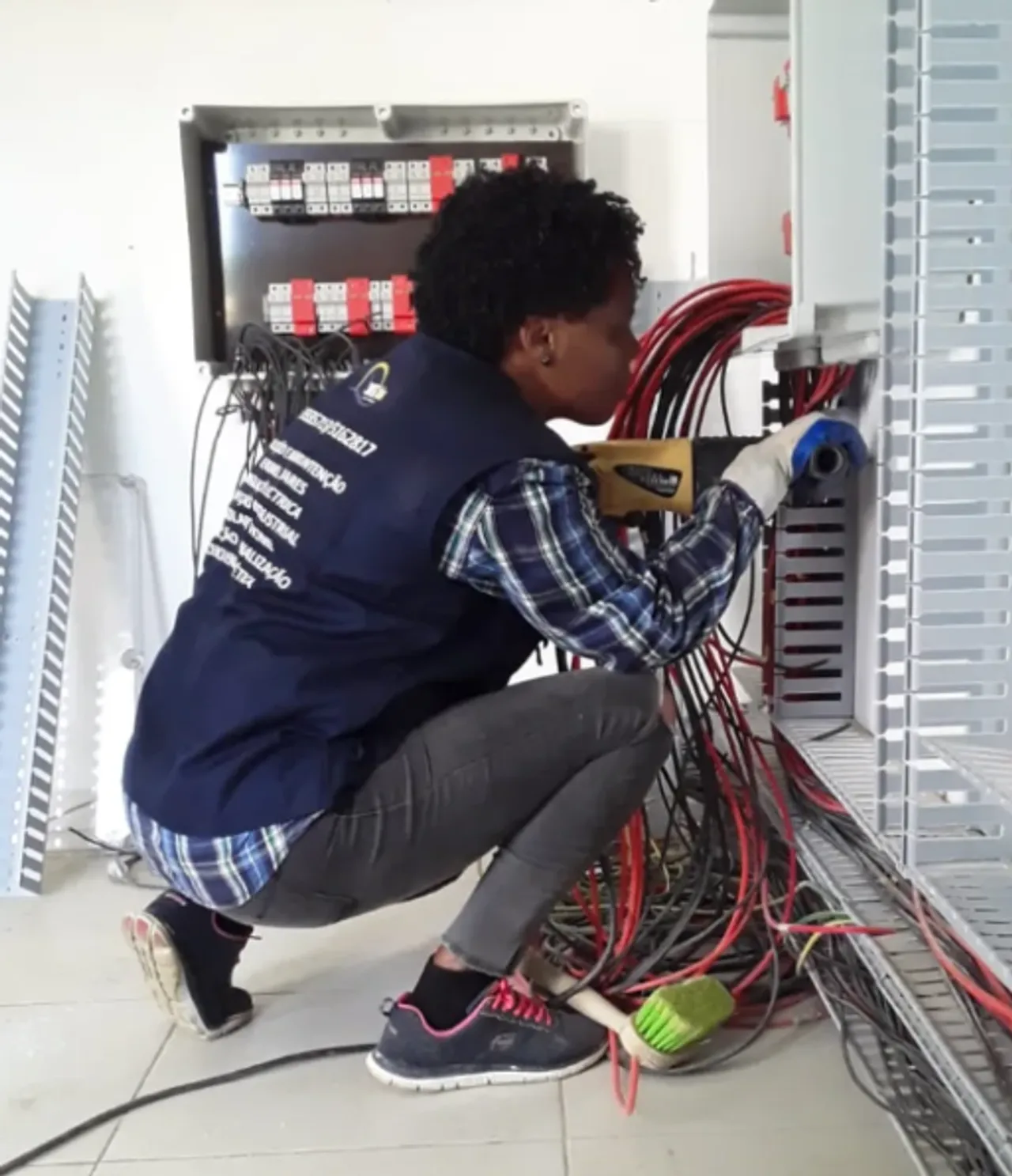
On the opposite side of the archipelago, on the windswept island of São Vicente, a different story unfolds. Carla dos Santos, 28, is a trained electrician—a rarity in a country where occupational segregation channels men into construction and STEM while women cluster in lower-paying service roles. She graduated top of her vocational class three years ago. She has yet to find stable work.
Employer discrimination
“I’ve had eight interviews. Eight times, they say, ‘You’re qualified, but the worksites are rough, and the clients won’t be comfortable with a woman,’” Carla says, standing outside the Mindelo vocational school where she once trained.
She now works part-time as a cleaner for a municipal office, earning less than half of what her male classmates make.
“I studied for four years to hold a screwdriver. Instead, I hold a mop. And the worst part? People tell me I should be grateful.”








Carla’s story reflects a deeper paradox. Cabo Verdean women are, on average, better educated than men, with a larger share having attended higher education. Yet women’s labor force participation lags dramatically: nationally, 61% of men hold full-time jobs compared to only 46% of women. In rural areas, 52% of women are completely outside the labor market, versus 28% of men. Even when women work, they earn at least 13% less per hour—a gap that persists even after accounting for education, experience, and occupation. The unexplained remainder points to employer discrimination, worsened by the absence of equal-pay-for-equal-work legislation.

For Dr. Aissatou Diallo, a labor economist who has advised West African governments on gender-inclusive growth, the Cabo Verde case is both frustrating and hopeful.
“What we see in Cabo Verde is a classic ‘endowment versus utilization’ paradox,” Diallo explains from her office in Dakar. “The country has invested heavily in girls’ education and health. Women are outperforming men on paper. But the labor market is still governed by 20th-century social norms. You cannot educate a woman into equality if she then goes home to 30 hours of unpaid care work per week while her husband does five. That is not a talent gap. That is a structural tax. And the World Bank’s estimate—12.2% of GDP—is actually conservative. When women earn, they reinvest 90% of their income into their children and households. The multiplier effect is enormous.”
Changing social norms
Diallo points to the four levers the World Bank identifies as essential: expanding affordable childcare on islands like Santiago, São Vicente, Sal, and Boa Vista; targeted vocational training for non-traditional sectors like renewable energy and construction; equal-pay legislation; and public campaigns to shift social norms.
“The childcare piece alone,” she says, “would bring thousands of women like Edna back into full-time work overnight.”
On many fronts, Cabo Verde shows that it can move fast on gender equality—from political participation to health and education. The next frontier, as the World Bank’s 2025 Economic Update makes clear, is the labor market. And the price of waiting is not just unfair. It is 12.2% of the nation’s future.
Back in Praia, Edna Monteiro has heard talk of a new government pilot program—a subsidized daycare center near her neighborhood, funded in part by a World Bank employment project. She is cautiously hopeful. But she also knows that laws and buildings don’t change minds overnight.
She glances at the clock on the wall. Her shift starts in 20 minutes. The invisible tax is already due.
“My own husband is a good man,” says Edna. “But when I asked him to watch the kids so I could take an evening class, he said, ‘That’s your job.’ He didn’t mean it cruelly. He just never thought otherwise.”