 Susan Mwongeli
If someone else wrote your history, built your education system, and designed the social media algorithms that decide what you see and what you do not, how free are you?
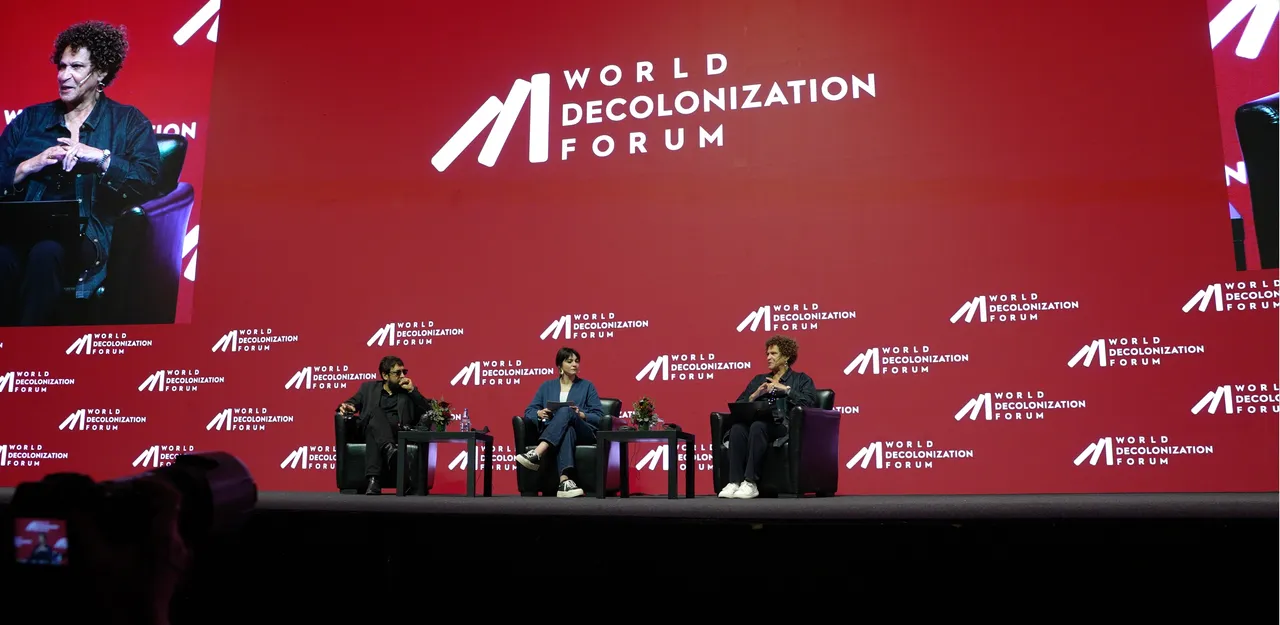
It is a question scholars, lawyers, economists and journalists have been debating for decades. And it took centre stage at the World Decolonisation Forum in Istanbul, Türkiye.
The two-day gathering of scholars, journalists and experts from 11 to 12 May, was held under the theme "Decolonising Knowledge Production and Circulation".
"I think what is very important, particularly with regards to the theme of this conference, is that ultimately the Global South has awakened. It is time that the Global South has learnt that we need to question hegemonic knowledges, hegemonic narratives about ourselves," Last Moyo, Policy Director of the Institute for Global South, told TRT Afrika at the conference.
The forum examined what organisers describe as the unfinished business of colonialism in how knowledge is produced and who controls it. To understand why this debate is still going on in 2026, you have to go back to the 1880s. The scramble for Africa was not only about land.
Colonial powers also took control of education, science, trade and language — in other words, they decided everything.
Scholars of decolonisation have long argued that decades after independence from colonialism, much of that did not change.
Those structures stayed put, in school curricula, in publishing systems, in economic models, and in which universities the world still looks to as authorities, as well as most recently in how the internet, particularly social media algorithms, reinforces those structures.
The sessions looked into how colonial codes are still embedded in education, culture and academia and how those same structures are shaping political, economic and social crises today.
Topics on the table include inequality in academic publishing, the dominance of certain languages in global research, data and algorithmic colonialism, and gaps in education and culture.
"If you look at, say, Francophone Africa as opposed to English-speaking Africa, our connection to France in the way that we consider curriculum and teaching makes it very difficult to extract ourselves from certain canons that, to me, are not terribly necessary for us today," Siba N’Zatioula Grovogui, a professor of Africana Studies at Cornell University in the US, told TRT Afrika.



"For Africans, however smart we are, our research interests, our lines of inquiry and literature are always motivated by grants to which we have to apply. We go with the availability of the grants and where they are.
But the questions are raised at critical times for other people to try to think about the world in a particular way. So, there are many structural issues that make it impossible for us to actually develop our own ideas," Professor Grovogui, who spoke at the conference, added.
Partner institutions come from Africa, Asia, Latin America and Europe. This comes as a renewed Pan-Africanism push gains momentum, with many African countries asserting their sovereignty across sectors and demanding a fairer global order.
"The Global South is coming back to reclaim its humanity, to reclaim its ontologies, its histories, its cultures. To say that there is nothing pathological about us. What is important is that we must sit at the global multicultural table with equal dignity as whiteness. We are not attacking white people, but we are attacking the ideology of whiteness, which is supremacist," Last Moyo stressed.
The forum is the first stage of a process running through to 2030, aimed at producing concrete proposals for fairer knowledge systems worldwide.
Experts believe much more has to be done to undo the historical biases and oppression of Africans, including in educational institutions.
"For those of us who are from West Africa, what has been at stake since the 17th century is that somebody has taken archives that belong to us and made disciplinary canons out of them to oppress us, to numb our minds and to occult reality to us," Grovogui said.
The conference was beyond panel discussions. Film screenings exploring colonial histories from Algeria to the Democratic Republic of Congo to Australia were also featured.
Whether any of this brings about lasting change is the real question. And for Africa, that answer could not matter more.