 Charles Mgbolu
For generations, people living near Luvilombo Falls in the Democratic Republic of the Congo have told stories that sounded implausible even by the standards of folklore: tiny fish, no longer than a finger, scaling sheer rock faces and ascending a waterfall.
In Sangala village, these accounts were passed down as legend. To outsiders and most western scientists, the idea that fish could climb a vertical river cascade rising some 15 metres was simply outrageous—impossible. For years, such claims were dismissed as exaggeration.
Now, recently published fieldwork conducted by some African researchers has turned up the evidence.
A research team led by Pacifique Kiwele Mutambala of the University of Lubumbashi, one of the largest universities in the Democratic Republic of the Congo, has documented thousands of freshwater fish, Parakneria thysi, ascending Luvilombo Falls during seasonal floods.
Using video and photographic evidence, the team captured what is arguably one of the most unusual vertebrate movements recorded on the continent.
“It is remarkable. This is the first time we are documenting this behaviour in Africa.” Mutambala tells TRT Afrika. “This is imagination surpassed by reality. I remember feeling both shock and a sense of satisfaction to finally see it. To be able to prove the origin and reasons for these tales of wall-climbing fishes.”
Defying gravity
According to the research work published this month, the ascent is nothing short of extraordinary. Only the smallest specimens, typically less than five centimetres long, attempt the climb, even though the species can grow to around 12 cm. Larger fish, the researchers say, do not make the climb.
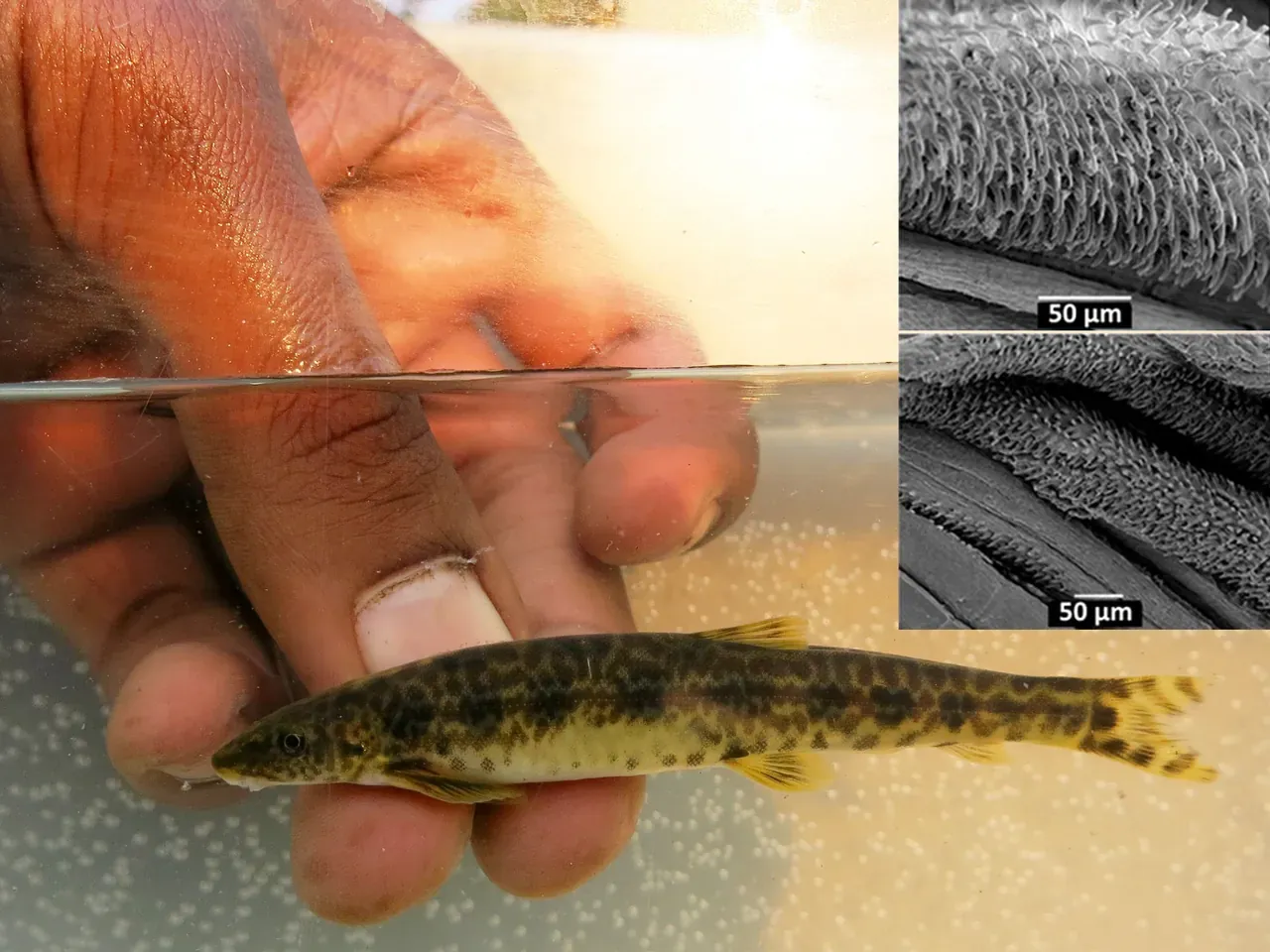
The researchers who observed the fish species between 2018 and 2020 say the mechanics of the climb reveal an incredible evolutionary solution. The fish possess hook-like projections on their pectoral and pelvic fins, allowing them to grip wet rock surfaces under powerful currents. Movement is incremental: adhesion, release, and a push upward driven by the tail.
“These are fish that love living in rapid environments. They are constantly pressed against the substrate. In this case, their adaptation is seen through the positioning of their pectoral and pelvic fins. You could say they are adapted to resist the current, but to say they are capable of climbing up was something else entirely,” Mutambala explains.
“How do they do this climb? First, it is boosted by flooding. During flood periods, they can be seen in the ‘splash zones'. They use their well-adapted pectoral and pelvic fins to grip the vertical wall. These fins are equipped with pads or small hooks that help them cling to the surface. They then use the caudal part—the tail fin—to try to push themselves up the falls.”
The climb itself is a test of endurance rather than speed. Individual fish specimens can take up to 9–10 hours to complete the journey, yet spend only around 15 minutes actively moving. The remainder is spent resting.
“It’s an enormous energy investment," Dr Emmanuel Vreven, an ichthyologist (fish biologist) at the Royal Museum for Central Africa, tells TRT Afrika. “When they arrive at a flat surface, they will pause for a longer time. When they recover the energy, they can begin another step of the climb. Most of the time is, in fact, used for resting.”
Even so, the ascent is perilous. Strong currents can dislodge the fish, and navigating overhangs or smooth rock faces can prove fatal.
The motivation for such a demanding migration appears to be ecological rather than reproductive.
Seasonal flooding transforms the base of the falls into slower, lake-like conditions—habitats that these fish, adapted to fast-flowing waters, may find unsuitable. Moving upstream offers access to more favourable environments.
The climb may also provide refuge. During floods, predators accumulate at the base of the falls. Ascending the cascade allows the fish to escape predation and exploit habitats with reduced competition.
“The behaviour likely reflects a combination of pressures: habitat change, food availability, and predator avoidance” Vreven explains.








A scientific puzzle
Interestingly, the discovery was not initially driven by curiosity about climbing behaviour. Instead, researchers were attempting to use the fish as biological markers to estimate the age of the waterfall.
“We were studying the Parakneria fish, using them as tools to date the waterfalls,” Mutambala and Vreven explain. “We wanted to try to date the falls by using the fish and their genetics. For other fish, it was possible to find differences between those upstream and those downstream. But for the Parakneria, we ran into a difficulty: there was no genetic difference between the fish at the top and those at the bottom.”
That absence of genetic divergence pointed to a missing piece of the puzzle: connectivity. Somehow, fish were moving upstream across what appeared to be an impassable barrier.
The answer, once observed, was as surprising as it was decisive.
Capturing the phenomenon required persistence—and proximity, says Mutambala. The researchers note that the behaviour is nearly impossible to detect from a distance.
“To observe them, we used two types of equipment. One was a camera inside a waterproof box that we placed against the waterfall wall to see them face-to-face. Other recordings were made with a more sophisticated camera with a zoom to keep it away from the water.”
“It wasn’t easy, but we did it,” Mutambala recalls.
Despite its resilience, this remarkable behaviour is vulnerable.
Human alteration of river systems—through water diversion, damming or overuse—could disrupt the delicate conditions that make the climb possible. Migratory species such as Parakneria thysi are particularly sensitive to such changes.
“It's purely a climatological problem,” Vreven warns. “For example, at the Lofoi Falls, water is extracted for irrigation. Sometimes the river is entirely diverted for that. That has a much larger impact than just climate change right now. If the falls dry up due to irrigation diversions, this remarkable migration becomes impossible.”
Touristic opportunities
At the same time, the phenomenon may offer an unexpected opportunity.
“This could attract eco-tourism,” Mutambala says. “People usually focus on the ‘Big Five’ animals (elephant, lion, leopard, African buffalo, and rhinoceros), but here we have a ‘climbing’ fish, which is a surprising observation that could generate interest in conservation for a group that is usually ignored.”
For Vreven, the significance of the discovery extends beyond a single species.
“There is power in this kind of observation. For many fish species, we have a name and know they exist, but we don’t know the details of their life history. This discovery again proves there are probably more mysteries around us than we realise."