The next phase of Africa’s digital economy may be shaped less by what the continent lacks and more by what it can skip.
That is the view of Adeniyi Adebayo, Chief Business Officer at Yango Ride, who says the absence of heavy legacy infrastructure gives many African countries a rare opportunity to leapfrog directly into the age of artificial intelligence, cloud computing and digital platforms.
Speaking to TRT Afrika, Adebayo argued that the continent is entering a period in which technology could transform not only online services but also agriculture, transport, manufacturing and infrastructure development.
The World Bank estimates that the digital economy already contributes more than 5% of Africa’s GDP, and analysts expect that share to grow as mobile internet access expands and digital services become more deeply embedded in daily life.
“If you compare Asia versus Africa versus Europe versus North America, you would see that we have the fastest-growing digital adoption globally.”
Generation that watched arrival of digital economy
For Adebayo, the scale of the transformation becomes clear when viewed through personal memory rather than statistics.
“Twenty-five years ago, there was nothing like the digital economy across the world, especially not in Africa. I remember very clearly when my mother bought the first Nokia 3310 phone in 2002.”
That experience, he says, illustrates how quickly an industry can emerge and create enormous value.
“The entire industry is barely 25 years old. Companies like Alphabet and Microsoft are now worth trillions of dollars. If you are an entrepreneur, it makes a lot of sense to get into a business that is growing this fast.”

Why Africa may adapt faster than richer regions
Adebayo believes one of Africa’s advantages is that many sectors are not burdened by expensive legacy systems.
“For a lot of African countries, we do not have a huge chunk of legacy technologies or legacy businesses. That means we can build faster and adapt to new technologies and new systems faster.”
He points to telecommunications as the clearest example. Before mobile phones, expanding connectivity required costly landline infrastructure. Mobile technology allowed countries to connect millions of people without first building extensive fixed networks.
“You have the opportunity in Africa to leapfrog some of those stages and build directly for the present.”
The Rwanda example: skipping the missing road
To explain what leapfrogging looks like in practice, Adebayo cites Zipline, the Rwanda-founded drone delivery company.
“They made drones to deliver medicine to remote areas. Why do you need drones? Because there are no roads. You can leapfrog the fact that you do not have roads and still deliver medicine.”
For him, that is a powerful African lesson: innovation does not always require replicating the infrastructure path taken by Europe or North America.
Adebayo says artificial intelligence is currently transforming knowledge work, but he expects its next wave to move into the physical world through robotics, drones and automated systems.
“Today AI is revolutionising digital spaces and how knowledge work happens. Over time it will spill over into the physical world.”
He argues that this could dramatically reduce production costs across multiple sectors.
“Imagine an era where a physical AI robot can do many of the specialised tasks that make infrastructure projects expensive. Knowledge becomes distributed, and the cost of deploying that knowledge falls sharply.”
In his view, the implications extend far beyond technology companies.
“The future is super exciting because AI can revolutionise agriculture, food, transportation, industry and many other sectors. What we are seeing now is only the beginning.”








AfCFTA: Political project, economic necessity
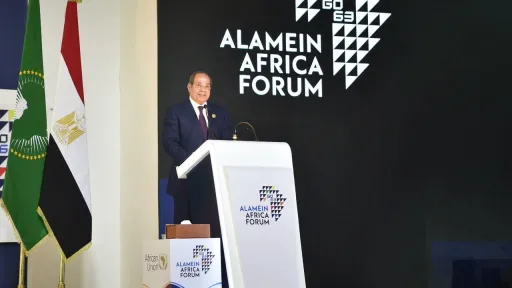
Adebayo also sees the African Continental Free Trade Area as a critical piece of the continent’s digital future, though he acknowledges the scale of the challenge.
“We have more than a billion people split into 54 countries. What governments are trying to do is not easy.”
He says the Pan-African Payment and Settlement System (PAPSS), which aims to facilitate cross-border payments in local currencies, is an important first step.
“Now money can move more freely. That is a very good movement in the right direction.”
But he insists payments alone are not enough.
“Next we need the movement of goods, services and people. If we get those next steps right, I think an era of abundance is waiting for Africa.”
Trade first, infrastructure second
One of Adebayo’s strongest arguments is that African governments should focus on enabling trade before expecting infrastructure to solve everything.
“When you have trade, then you have something to tax. If there is no trade, there is nothing to tax.”
He contrasts economies that depend heavily on extracting natural resources with those that generate revenue from transactions between businesses and consumers.
“Today many African governments are taxing what comes out of the ground, not what happens between people. If you can tax trade between people, then you create the fiscal base to invest in infrastructure.”
According to Adebayo, the continent has already achieved partial integration in communications and, in some regions, in the movement of people.
“I am not paying any tax to talk to you. We have WhatsApp, Zoom and other platforms. There is already a free flow of communication.”
Regional blocs such as ECOWAS and the East African Community have also made progress on mobility.
“What we have not fully unlocked is the easy flow of money and goods.”

The regulation obstacle
For companies operating across several African markets, fragmented regulation remains a major obstacle.
“If you are driving for Yango in Côte d’Ivoire, there is one set of regulations for cars, drivers and taxi partners. Those rules do not automatically apply in Cameroon or Senegal.”
Each new market requires fresh negotiations and compliance processes.
“You go to a new country, and it is a new conversation and a new set of rules.”
Adebayo says Yango’s approach has been to engage openly with regulators and governments, with the broader goal of creating frameworks that support cross-border services.
Despite the obstacles, Adebayo remains optimistic that deeper integration could unlock far greater levels of trade between neighbouring African countries.
“If we bring the right infrastructure and the right regulations on board, there is no reason there should not be much more trade between neighbours than we have today.”
For him, the bigger story is not simply the growth of ride-hailing or digital apps. It is the possibility that Africa could combine rapid digital adoption, AI-driven innovation and a more integrated continental market to create a new phase of economic growth.
“We are only at the beginning. The opportunity is not just to digitise existing businesses, but to build entirely new systems that were not possible before.”